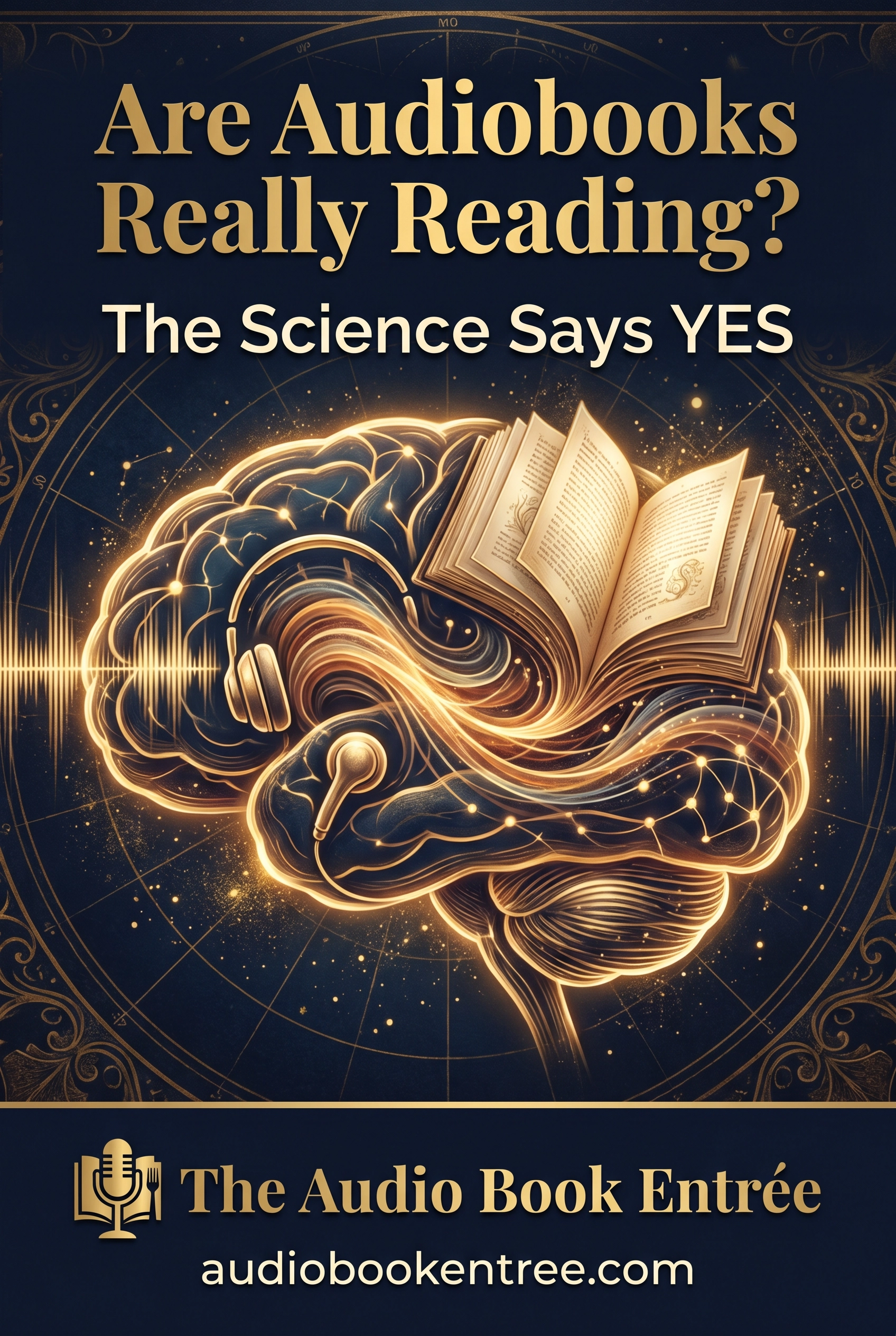
You have probably heard it — or said it yourself. "I don't really read. I just listen to audiobooks." There is a quiet guilt that follows audiobook listeners around, a nagging sense that listening somehow doesn't count. That it's cheating. That real readers use their eyes.
Science disagrees. Emphatically.
Over the past decade, neuroscientists, cognitive psychologists, and reading researchers have studied what actually happens in the brain when we read versus when we listen — and the results are striking. The guilt, it turns out, is entirely unfounded.
What the Brain Actually Does When You Listen
In 2019, researchers at the University of California, Berkeley published a landmark study in the Journal of Neuroscience. Using fMRI brain scans, they mapped which parts of the brain activated when participants read stories versus listened to the same stories as audio. The finding was unambiguous: the same semantic regions of the brain lit up in both cases. The brain's language-processing network — the areas responsible for extracting meaning, building narrative, and understanding character — responded identically whether the words arrived through the eyes or the ears.
The lead researcher, Jack Gallant, described it this way: the brain doesn't care how the words get in. What it cares about is what those words mean.
A separate study published in Psychological Science by Dr. Beth Rogowsky at Bloomsburg University tested comprehension directly. Participants were split into three groups: one read a non-fiction book on a Kindle, one listened to the same book as an audiobook, and one did both simultaneously. When tested on comprehension afterwards, there was no statistically significant difference between the groups. Readers and listeners understood the material equally well.
The "Cheating" Myth — Where It Comes From
The idea that audiobooks are somehow inferior has its roots in how we learned to read as children. Reading instruction focuses on decoding — the mechanical process of converting letters into sounds. When a child struggles with decoding, listening to a story is sometimes used as a workaround, which can create the impression that listening is a crutch for those who can't manage the "real" thing.
But this conflates two entirely different skills. Decoding is a mechanical process. Comprehension — understanding, feeling, and retaining a story — is a cognitive and emotional one. And it is comprehension that matters for adults who read for pleasure, knowledge, or growth.
As Harvard reading specialist Maryanne Wolf puts it: once you have learned to decode, the route the words take to your brain becomes largely irrelevant. The meaning-making machinery is the same.
Where Listening Has the Edge
There are areas where listening to a book is not just equal to reading it — it is demonstrably better.
Emotional engagement. Research consistently shows that listening activates the auditory cortex and emotional processing centres more strongly than silent reading. A skilled narrator conveys tone, subtext, and character in ways that a reader's internal voice often cannot match. The pause before a revelation. The tremor in a character's voice. These are things print cannot fully replicate.
Pronunciation and language acquisition. Hearing words spoken correctly — especially in literary fiction, where vocabulary tends to be richer — builds a more accurate mental model of language than reading alone. Listeners of audiobooks consistently report learning new words more confidently because they have heard them used in context.
Accessibility and volume. For people with dyslexia, visual impairments, or attention difficulties, audiobooks are not a compromise — they are the optimal format. And for anyone with a busy life, audiobooks unlock reading time that would otherwise be lost: commutes, gym sessions, cooking, walking the dog. The person who listens to 30 books a year while commuting is reading more than the person who manages 5 books in the evenings.
Where Reading Has the Edge
Honesty requires acknowledging that reading and listening are not identical in every context. For highly technical material — legal documents, academic papers, complex non-fiction with dense data — studies do show that visual reading tends to produce better retention. The ability to re-read a sentence, pause, and annotate gives print an advantage when the material demands close analysis.
But for narrative fiction, memoir, biography, self-help, and the vast majority of popular non-fiction? The research shows no meaningful difference. The story gets in. The ideas land. The emotions register.
The Verdict
Listening to an audiobook is reading. It is reading with your ears instead of your eyes, and the brain processes it in almost exactly the same way. The guilt is a cultural hangover from childhood reading instruction, not a reflection of cognitive reality.
The next time someone tells you that audiobooks don't count, you can tell them that the neuroscience disagrees. The same semantic networks activate. The same stories are understood. The same ideas take root.
The only thing that matters is that you are reading. However the words get in.
Ready to start listening?
Check Audible's current offer and get a complimentary audiobook where included in the offer; review the terms before signing up.
🎧 Check Audible's Current OfferAffiliate disclaimer: This article contains affiliate links. If you sign up for an Audible trial through our links, we may earn a small commission at no extra cost to you.
Audible offer
Check the current Audible offer for your country and account. Where an offer includes a complimentary audiobook, review the terms before signing up.
Check Today's Offer →Check Audible's Current Offer for Are Audiobooks Really Reading? The Science Says Yes
Check the current Audible offer for your country and account. Where the offer includes a complimentary audiobook, review the terms before signing up.
Check Today's Audible Offer →Offer terms vary by country and eligibility
This article contains affiliate links. As an Amazon Associate and Audible Creator Programme participant, The Audio Book Entrée earns from qualifying purchases. If you use an Audible offer through our links, we may earn a small commission at no extra cost to you. Offer availability, pricing, duration and included benefits vary by country and account; review the terms before signing up. Our recommendations are based on the research and evidence described in our editorial approach.
Keep exploring features audiobooks chosen to pair with this review.




Check Today's Audible Offer
Audible offers vary by country, eligibility and customer status. Check the current terms displayed on Audible before signing up.
View Audible's Current Offer →